Meta Description: Discover how you can carry out keyword research for SEO in 2026. From knowing why people look for information on Google search to using the tools and carrying out research on long-tail keywords that work.
Whenever I began to learn about SEO, just like any other newbie I focused on the numbers. Many people searching for something seemed to be the most important part of all. When a particular keyword had ten thousand searches monthly, I imagined that writing on keyword research for SEO would attract many people to my site. I was looking for keyword research for SEO.
What made the difference for me is when I understood that volume without intent is just that—noise. You could have the highest ranking for a keyword but no conversions because you’ve answered the wrong question for the wrong person. It became the turning point for my keyword Research for Seo and is the core concept behind this whole guide.
No matter what level you’re at or where you want to go in 2026, this guide will show you how to do keyword Research for Seo the right way.
What Is Keyword Research (And Why Most People Get It Wrong)
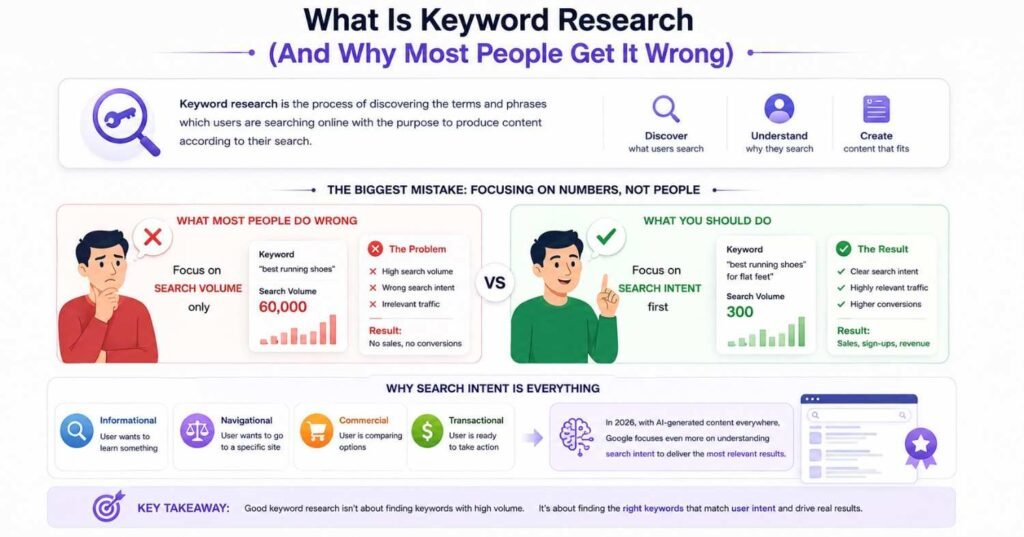
The thing which changed my perception about SEO completely was understanding that search volume without search intent is just a noise. It does not matter whether you rank on page one for a certain keyword if you get zero keyword Research for Seo is the process of discovering the terms and phrases which users are searching online with the purpose to produce content according to their search. Although the concept seems quite simple, in reality, almost all newcomers make the same mistake thinking about keyword research in terms of counting numbers rather than user psychology.this is the foundation of Keyword Research for Seo.
The most common mistake for them is being preoccupied with search volume while forgetting completely about the search intent. No matter how high the search volume is for certain keywords, if the people searching for them do not need anything which you offer then such keywords would not do you any good. On the other hand, a long-tail keyword with the search volume of only 300 searches per month but which attracts exactly the users who need your product would be priceless.
With the development of AI-generated content in 2026, Google ranking system becomes even more focused on the search intent.
Step 1: Start With the Topic, Not the Keyword
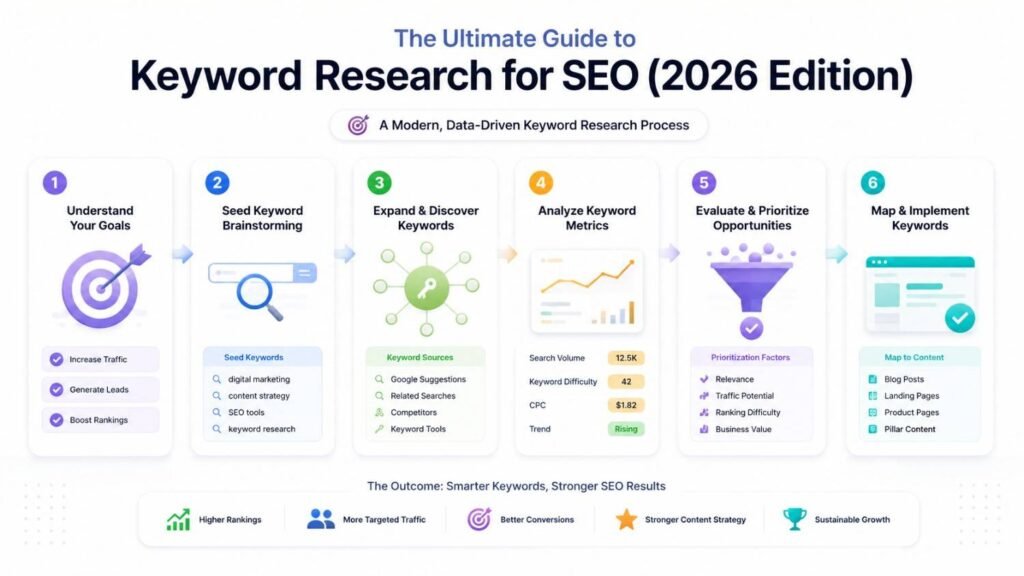
Before getting started with the keyword analysis tool, there are several things that you should know about your topic and about your target audience. You should ask yourself a couple of questions.this is the first step in keyword Research for Seo.
How does my target audience resolve its problems?
What position is my target audience at on its path?
How can I please my target audience by the text I’m writing?
It’s important for you to think about it since all this information may influence your choice of keywords.
In case I begin writing my article, the first step I make is thinking of my target audience. I’m thinking of whom I write the article for. this is an important part of Keyword Research for Seo.
Step 2: Use the Right Tools (Without Over-Relying on Them)
It should be noted that it does not require significant expenses to obtain keywords. Below there are mentioned simple and handy tools:
* Google Search. This one is the most common place to start. Input the topic and observe the keyword suggestions offered under “People Also Ask” and at the bottom of the page in “related searches”. Actually, Google shows its users the popular queries.
* Google Keyword Planner. If you have an account with Google Ads, then you may use this tool for free. It provides information about the search volume and competition level of the chosen term according to Google.
* Ubersuggest. The keyword suggestion and analysis, estimation of the ranking difficulty and the competitive research are among the functions performed by this tool.
As for the one of the things to remember: the keyword difficulty score serves just as a rough guide. In each case, I check the content of the first page of the search results myself. Thus, sometimes it turns out that despite being described as difficult to rank for, the particular keyword has no valuable results on the first page, and vice versa, a keyword with low competition is dominated by authoritative websites.
Step 3: Decode Search Intent Before You Write a Single Word
It needs to be mentioned that it does not take huge efforts to get keywords. There is a mention ofBelow there is a mention of the step that many guides ignore, but which is actually the most crucial one.
Search intent means an underlying purpose of a search query. It is determined by Google in the following way:
Informational (“How does keyword research work?”) — the person is looking for information.
Navigational (“Ahrefs login”) — the person is trying to find a certain page.
Commercial (“Best keyword research tools 2026”) — the person is comparing the offers.
Transactional (“Buy SEMrush subscription”) — the person is willing to buy.
In order to identify the search intent of any keyword, you need to google it. Just check the first five results – are they blogs, products, videos or listicles? This format is your indicator. If the top positions are filled only with “how to” guides, Google has recognized your query as an informational one, and it will not help to write a product page on this topic even with perfect optimization.
I have never written underperforming content due to the habit of googling my keywords before.
Step 4: Prioritize Long-Tail Keywords as a Beginner
If your website is new and does not have authority yet trying to compete for high-volume keywords is like showing up to a Formula 1 race on a bicycle. You are not going to win.
When you are just starting out long-tail keywords are your bet. These are phrases that’re more specific and usually have three to five words.
Long-tail keywords have some things going for them:
* They have search volume, which’s okay.
* They have competition so you can actually get a ranking.
* They have intent so you get qualified visitors.
* They have conversion rates because people know what they are looking for when they use long-tail keywords.
For example of using “keyword research” as your target a beginner might use “how to do keyword research for a new blog in 2026”. This is a phrase where you have a chance of getting a ranking and the person searching for it is exactly the kind of person you want to reach.
As your website grows and gets backlinks and authority you can start to use competitive keywords like the broad and high-volume keywords you could not use before. You can work your way up, to these keywords gradually. Use long-tail keywords to get started with your website. Long-tail keywords are a way to begin and then you can move on to broader keywords as your website becomes more established.
Step 5: Know When You’ve Found the Right Keyword
Good keyword research has an end goal. You know you have a keyword when:
* The search intent clearly matches the content you plan to create
* The competition is something you can handle with your website authority
* The topic really matters to your audience
* The search engine results page shows gaps in content that your article can fill better, than whats there
When all these conditions are met you are ready to write. Not before.
A Note on Keyword Difficulty Scores
Tools like Ubersuggest and Google Keyword Planner give you difficulty or competition scores to help prioritize keywords. These are useful starting points, but treat them as one input among several — not the final answer.
A low difficulty score on a keyword Research for Seo with terrible existing content is a green light. A low difficulty score on a keyword dominated by Reddit threads and YouTube videos (which Google loves to rank) might still be hard to break into with a traditional blog post. Context always wins over the number on the screen.
Frequently Asked Questions
Word Counter
How long does keyword research take to complete?
Keyword Research for Seo takes a lot of time. It is not something you can do quickly. When I start working on a blog post it usually takes me 30 to 60 minutes to research the keywords.
As I get practice and develop my own way of doing keyword Research for Seo it gets faster for me to complete. I do not want to rush the keyword research process because the decisions I make about keywords affect everything that I do with my blog post and keyword research.
How keywords should I target per article?
I focus on one keyword and two to four other keywords that are closely related to the keyword and to keyword research. If I try to rank for terms in one article it makes my content unclear and I do not want to confuse the search engines about what my articles actually about with too many keywords.
Do I need a paid tool to do keyword research?
No I do not need a paid tool to do my keyword Research for Seo and to do keyword research. I use Google Search, Google Keyword Planner and the free version of Ubersuggest. These tools are enough for me to start my keyword research. Paid tools can provide a lot of data. Are better for large projects but they are not necessary for beginners like me who are just starting out with keyword research.
What is the difference between short-tail keywords and long-tail keywords?
Short-tail keywords are phrases that have a lot of searches and a lot of competition like in keyword research. For example “SEO tips” is a short-tail keyword.
Long-tail keywords are phrases that have searches like “SEO tips for business blogs in 2026”. They are easier to rank for and attract visitors who are looking for something doing keyword research.
I use both short-tail keywords and long-tail keywords in my keyword Research for Seo. Short-tail keywords help me understand what people are searching for on the internet and doing keyword research. Long-tail keywords help me create content that meets the needs of my target audience. I do keyword research.
Keyword research is a part of my content creation process. I do keyword research. It helps me to create content that is relevant and useful to my readers. I do keyword research to create content that my readers will like and to do keyword research. Keyword research is important to me because it helps me make sure my content is what people are looking for. I do keyword research, for every blog post I write and keyword research.
Final Thought: Stop Chasing Volume, Start Chasing Intent
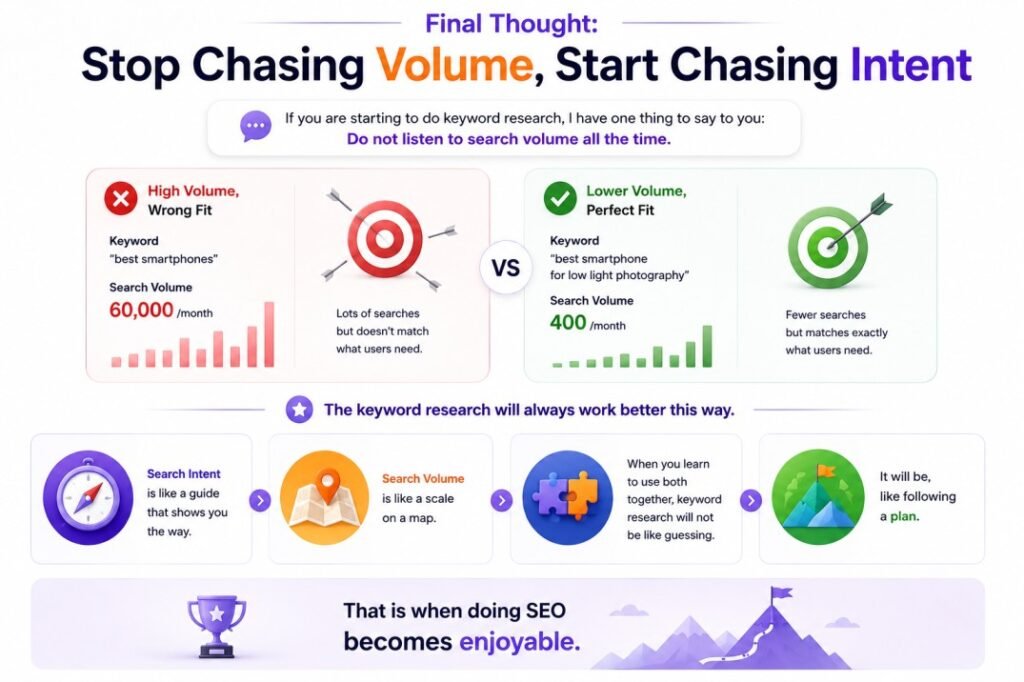
If you are starting to do keyword research for seo I have one thing to say to you: do not listen to search volume all the time.
A keyword that is what people are looking for even if only 400 people search for it every month is better than a keyword with a lot of searches that does not fit perfectly.
The keyword research will always work better this way.
Search intent is like a guide that shows you the way.
The number of searches is like a scale on a map.
When you learn to use both search intent and the number of searches together, doing keyword research foe seo will not be like guessing
It will be, like following a plan.
That is when doing SEO becomes enjoyable.